|
|
|
|
|
|
|
|
|
|
|
|
|
|
 |
|
||||||||||||
|
|
|
|
|
|
|
|
|
|
|
|
|
|
|
|
|
||||||||||||
| DragSim5 Vehicle-Dynamics 1/4- or 1/8-Mile Drag-Strip Simulation Includes ProTools™ Enhancements | ||||
|
DragSim5™
with ProTools™ is an
amazingly accurate 1/4- and 1/8-mile vehicle-dynamics
simulation for
Windows Vista, 7, 8, and 10 (32- and 64-bit) from the
experts at Motion Software, Inc. The simulation lets you to design and build any car, motorcycle or dragster
and accurately evaluate its performance at simulated dragstrip! Enter
any engine power curve, or test engines you've designed in DynoSim or Dynomation (you
can even test a variety of jet and rocket power plants!).
Test any manual or automatic transmissions, any gear ratios, any vehicle
weight, wheelbase, driving style, weather and traction conditions and more! Change
components with just a mouse click—drag-race times are instantly
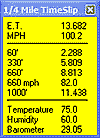
updated. A PopUp TimeSlip™ provides an easy-to-read visual summary of
overall vehicle performance. Even
test and compare multiple vehicles at once! Software Overview: DragSim5 simulates virtually any Automobile, Dragster, or Motorcycle using front- or rear-wheel drive! The simulation performs a comprehensive analysis of the physics that act on the vehicle as it accelerates from a standing start to terminal velocity over the 1/8- or 1/4-mile. This iterative (repeating, step-by-step) analysis determines vehicle performance for each fraction of an inch throughout the entire race. The results display looks similar to a professional data-acquisition system! You'll clearly see exact elapsed times, speeds, rpms, beginning at rollout to 60 feet, 330 feet, 660 feet (1/8-mile), 1000 feet, and 1320 feet (1/4-mile). ETs and speeds can be compared with up to four other vehicles to help locate the best component combinations. User Interface And
Features: DragSim5 has a completely
unique user interface built from the
ground-up to be clear and easy use. You'll find vehicle component parts and
specifications on the left side of the screen, and simulation results on the
right! Eye-popping graphics are Even though this program is sophisticated, DragSim5 was carefully designed to be easy to use. For example, a Pop-Up TimeSlip™ provides an instant summary of the performance potential of any vehicle. A quick glance will help you make judgments about gear ratios, shift points, vehicle weight, and it can even help you evaluate traction and wheelspin!. Similar to the paper time slip delivered to racers at the end of a run, the DragSim5 Pop-Up TimeSlip™ is a helpful, at-a-glance analysis of track results.
ProTools™: Professionals need all the modeling power they can get. The ProTools™ included in DragSim5 extend the functionality of many program features. For example, the ProIterator™ lets you perform fully custom testing, DataZones™ give you the most graphing and data analysis power possible, ProData™ includes a new table of extended vehicle performance data, and ProPrinting™ prints out a comprehensive test report that can include your name, address, custom logo, glossaries, and all ProData™ values. If you're serious about drag racing, the DynoSim5 with ProTools™ was made for you! Technical (under the
hood):
DragSim5 simulates the complex physics involved in 1/8- and
1/4-mile drag racing, including the incredible range of forces that act on
automobiles, dragsters, or motorcycles at the starting Users Manual: The DragSim5 is supplied with a full-color on-disk Users Manual (directly accessible from within the program) that details the features of this comprehensive simulation. If you wish, you can download a copy of this manual to preview the capabilities of this software before you buy (link provided at top of this page). Requirements: DragSim5 runs on any Windows 7, 8 10 or 11 equipped PC. A video display of 1024 x 768 resolution or greater is recommended. A Windows-compatible printer is required for test reports. Availability: The DragSim5 is available NOW!. See our Order Page for purchase information and Discount pricing. What You Can Do With The DragSim:
Tune These Key Vehicle Components:
What The Pros Say About The DragSim:
|
Compare Our Drag
Simulation
FREE—Download
Special Web Pricing What's New This Version:
Features:
Requirements:
|
|||
|
|
|
|
|
|
|
|
|
|
|
|
|
|
In the modern landscape, NASA’s textual archives have found a new purpose: the development of Artificial Intelligence. Large Language Models (LLMs) rely on high-quality, factually dense data to learn complex reasoning and technical vocabulary. By making vast datasets available to the public, NASA provides a "gold mine" for developers. A 4,000-line text file of NASA reports can help an AI understand the nuances of orbital mechanics or the chemical composition of Martian soil. This open-data philosophy accelerates innovation not just in aerospace, but in any field that utilizes natural language processing to solve complex problems. Democratizing Science
For decades, the National Aeronautics and Space Administration (NASA) has stood as a beacon of human ingenuity, pushing the boundaries of what is possible in space exploration and scientific discovery. However, beyond the spectacular images of distant nebulae and the historic footage of moonwalks lies a less visible but equally critical asset: an immense repository of textual data. Files like the "Nasa 4k000.txt" represent a microcosm of this legacy—distilling complex engineering triumphs and scientific inquiries into a format that is universally accessible and perpetually durable. The Utility of the Plain Text Format Download Nasa 4k000 txt
While a file named "Nasa 4k000.txt" may appear to be a mere collection of characters and numbers, it is in fact a testament to the enduring value of shared knowledge. It represents a commitment to transparency, a bridge between generations of technology, and a fuel source for the future of artificial intelligence. As we continue to reach for the stars, the words we leave behind in these digital archives will remain the map that guides future explorers home. In the modern landscape, NASA’s textual archives have
The Digital Legacy: NASA’s Data Archives and the Power of Textual Information A 4,000-line text file of NASA reports can
The choice of a .txt format for large-scale data storage is both a practical and a strategic one. In an era of proprietary software and rapidly evolving file types, the plain text file remains the "gold standard" for archival longevity. It requires no specialized software to read, occupies minimal storage space, and is easily indexed by search engines and AI training algorithms. For NASA, whose missions can span decades, ensuring that a report written in 1970 is still readable on a computer in 2070 is paramount. These text files serve as the foundational building blocks for the global scientific community, allowing researchers to parse through millions of words of mission logs and technical specifications. Fueling the Next Generation of Intelligence
Perhaps the most significant impact of these downloadable text files is the democratization of information. When NASA publishes its findings in simple, downloadable formats, it removes the barriers between elite institutions and the general public. A student in a remote area can download the same technical data used by aerospace engineers, fostering a new generation of scientists and explorers. It transforms the agency from a government entity into a global classroom. Conclusion

 performance or
racing application, automatically! DragSim5 is the most powerful and
easy-to-use straight-line vehicle-dynamics simulation available! And it’s
fun to use, too!
performance or
racing application, automatically! DragSim5 is the most powerful and
easy-to-use straight-line vehicle-dynamics simulation available! And it’s
fun to use, too!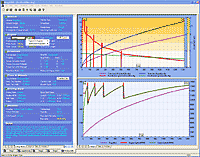 enhanced with
QuickAccess™ buttons and
DirectClick™
menus that let you change parts simply by clicking on any component. Analyze engine
RPM, Clutch RPM, Torque Converter Stall Speed, Acceleration, Tire Slip, Distance, ET, Aero Drag, and much more
(detailed below). All data and graphs can be
printed (and previewed) in color.
enhanced with
QuickAccess™ buttons and
DirectClick™
menus that let you change parts simply by clicking on any component. Analyze engine
RPM, Clutch RPM, Torque Converter Stall Speed, Acceleration, Tire Slip, Distance, ET, Aero Drag, and much more
(detailed below). All data and graphs can be
printed (and previewed) in color.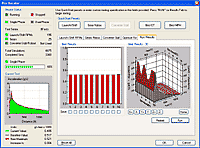 DragSim5 also incorporates
(Motion-exclusive) technology that helps you find
optimum combinations for any vehicle. To
start off,
the simulation includes a
Traction Calculator™ that optimizes tire/track modeling and
improves accuracy. A simple button click begins a comprehensive series of
hundreds of thousands of calculations to determine the tire/track adhesion
model that best simulates read-world conditions. You'll also be amazed by
Iterator™ testing built into DragSim5 that lets you "home in" on the best parts combinations, automatically!
Click one button and DragSim will perform hundreds,
or thousands of
drag tests! The Iterator™ keeps
track of all the results, and displays the best gear ratios and other parts combinations for you to review.
You'll locate the setup that delivers the quickest ET or the fastest MPH for any
street or racing application!
DragSim5 also incorporates
(Motion-exclusive) technology that helps you find
optimum combinations for any vehicle. To
start off,
the simulation includes a
Traction Calculator™ that optimizes tire/track modeling and
improves accuracy. A simple button click begins a comprehensive series of
hundreds of thousands of calculations to determine the tire/track adhesion
model that best simulates read-world conditions. You'll also be amazed by
Iterator™ testing built into DragSim5 that lets you "home in" on the best parts combinations, automatically!
Click one button and DragSim will perform hundreds,
or thousands of
drag tests! The Iterator™ keeps
track of all the results, and displays the best gear ratios and other parts combinations for you to review.
You'll locate the setup that delivers the quickest ET or the fastest MPH for any
street or racing application!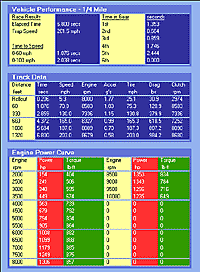 line. But you can leave your physics books on the shelf, because the
DragSim5 makes complex vehicle analysis as easy as 1, 2, 3. Pop-up menus allow you to enter any
engine power curve (also import DynoSim6 and Dynomation6 and other engine files). You can even test jet
or rocket power plants! Then choose vehicle components from simple drop-down
menus or enter custom specs for automatic or manual transmissions, torque
converter stall-speed, launch rpm, shift rpms, up to six transmission gears
with virtually any gear ratios, rear-axle ratios, vehicle weight, wheelbase,
front- or rear-wheel drive, frontal area, aero drag, tire width, rollout
distance, ambient temperature, humidity, wind speed, and more! Internal
"watchdogs" eliminate conflicting choices (like an rpm redline rpm set lower
than a shift rpm, etc.), ensuring accurate performance predictions.
line. But you can leave your physics books on the shelf, because the
DragSim5 makes complex vehicle analysis as easy as 1, 2, 3. Pop-up menus allow you to enter any
engine power curve (also import DynoSim6 and Dynomation6 and other engine files). You can even test jet
or rocket power plants! Then choose vehicle components from simple drop-down
menus or enter custom specs for automatic or manual transmissions, torque
converter stall-speed, launch rpm, shift rpms, up to six transmission gears
with virtually any gear ratios, rear-axle ratios, vehicle weight, wheelbase,
front- or rear-wheel drive, frontal area, aero drag, tire width, rollout
distance, ambient temperature, humidity, wind speed, and more! Internal
"watchdogs" eliminate conflicting choices (like an rpm redline rpm set lower
than a shift rpm, etc.), ensuring accurate performance predictions.